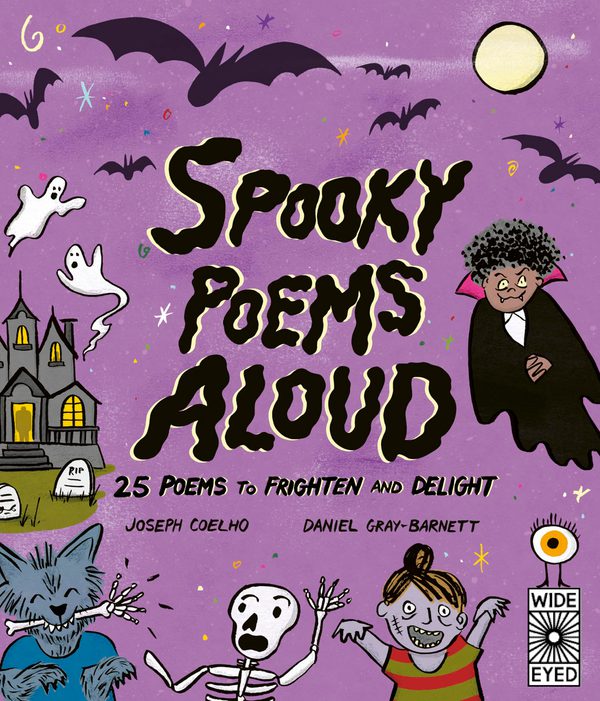
Exploring Poetry and Rhythm with ‘Spooky Poems Aloud’ by Joseph Coelho
- Learning level
- First
- Genre
- Poetry
- Curriculum area
- Literacy & English, Expressive Arts, Social Studies
- Year published
- 2024
Overview
The aim of this resource is to give ideas on how to introduce poetry through cross-curricular learning activities for children in P2-4. It contains ideas for exploring poetry and writing in your classroom as well as inspiration for using the book across the curriculum as part of Halloween themed activities.
Note to teachers: We recommend reading the book carefully before using it in the classroom or recommending it to pupils, using your best judgement to determine whether the topics covered are appropriate for your class.
Outcomes and impacts
The content and activities in this learning resource are designed to support learning outcomes in relation to the curriculum as well as the UNCRC articles.
Curriculum of Excellence:
- Social Studies (People, past events and societies)- I can compare aspects of people’s daily lives in the past with my own by using historical evidence or the experience of recreating an historical setting. SOC 1-04a
- Expressive Arts (Drama) - I enjoy creating, choosing and accepting roles, using movement, expression and voice. EXA 1-12a
- Literacy (Reading - Understanding analysing and evaluating) - To show my understanding across different areas of learning, I can identify and consider the purpose and main ideas of a text. LIT 1-16a
- Literacy (Reading - Enjoyment and choice) - regularly select and read, listen to or watch texts which I enjoy and find interesting, and I can explain why I prefer certain texts and authors. LIT 1-11a / LIT 2-11a
- Literacy (Writing - Tools for writing) - Throughout the writing process, I can check that my writing makes sense. LIT 1-23a
UN Convention on the Rights of the Child (UNCRC):
- Article 3 (best interests of the child) The best interests of the child must be a top priority in all decisions and actions that affect children.
- Article 13 (freedom of expression) Every child must be free to express their thoughts and opinions and to access all kinds of information, as long as it is within the law.
- Article 14 (freedom of thought, belief and religion) Every child has the right to think and believe what they choose and also to practise their religion, as long as they are not stopping other people from enjoying their rights. Governments must respect the rights and responsibilities of parents to guide their child as they grow up.
- Article 29 (goals of education) Education must develop every child’s personality, talents and abilities to the full. It must encourage the child’s respect for human rights, as well as respect for their parents, their own and other cultures, and the environment.
- Article 31 (leisure, play and culture) Every child has the right to relax, play and take part in a wide range of cultural and artistic activities