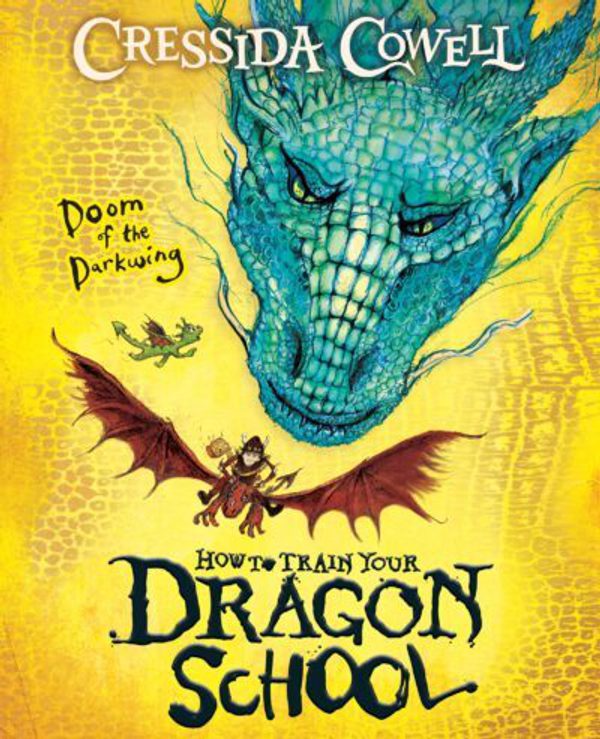
How to Train a Dragon School: Doom of the Darkwing by Cressida Cowell
- Genre
- Fiction
- Curriculum area
- Health & Wellbeing, Expressive Arts, Literacy & English
- Year published
- 2025
Overview
Explore the mystical world of How to Train Your Dragon School as Hiccup and his friends face an unexpected and menacing new enemy with fantasy writing legend Cressida Cowell
This learning resource is connected to the particular ‘Doom of The Darkwing’ novel, part of the wider How to Train Your Dragon series from Cressida Cowell. You may want to inform your students on the pre-existing series and its extensive novels, however, knowledge of their plot is not necessary to follow this book and therefore the resource.
Note to teachers: We recommend reading the book(s) carefully before using it in the classroom or recommending it to pupils, using your best judgement to determine whether the topics covered are appropriate for your class.
Outcomes and impacts
The content and activities in this learning resource are designed to support learning outcomes in relation to the curriculum as well as the UNCRC articles.
Curriculum of Excellence:
- Health and Wellbeing (Mental and emotional wellbeing) - I understand that my feelings and reactions can change depending upon what is happening within and around me. This helps me to understand my own behaviour and the way others behave. HWB 1-04a / HWB 2-04a
- Literacy (Reading: Understanding, analysing and evaluating) - To show my understanding across different areas of learning, I can identify and consider the purpose and main ideas of a text and use supporting detail.
LIT 1-16a/LIT 2-16a - Literacy (Writing: Creating Texts) - I can convey information, describe events or processes, share my opinions or persuade my reader in different ways. LIT 1-28a / LIT 1-29a
- Literacy (Writing: Creating Texts) - I can convey information, describe events, explain processes or combine ideas in different ways. LIT 2-28a
- Expressive Arts (Art and Design) - I can respond to the work of artists and designers by discussing my thoughts and feelings. I can give and accept constructive comment on my own and others’ work. EXA 1-01a / EXA 2-01a
UN Convention on the Rights of the Child (UNCRC):
- Article 13 (freedom of expression) Every child must be free to express their thoughts and opinions and to access all kinds of information, as long as it is within the law.
- Article 14 (freedom of thought, belief and religion) Every child has the right to think and believe what they choose and also to practise their religion, as long as they are not stopping other people from enjoying their rights. Governments must respect the rights and responsibilities of parents to guide their child as they grow up.
- Article 17 (access to information from the media) Every child has the right to reliable information from a variety of sources, and governments should encourage the media to provide information that children can understand. Governments must help protect children from materials that could harm them.
- Article 28 (right to education) Every child has the right to an education. Primary education must be free and different forms of secondary education must be available to every child. Discipline in schools must respect children’s dignity and their rights. Richer countries must help poorer countries achieve this.
- Article 29 (goals of education) Education must develop every child’s personality, talents and abilities to the full. It must encourage the child’s respect for human rights, as well as respect for their parents, their own and other cultures, and the environment.
- Article 31 (leisure, play and culture) Every child has the right to relax, play and take part in a wide range of cultural and artistic activities